- Home
- Resources
Resources
Technical data, safety data and certificates — no registration
Full technical data for the E, EZ, P480, P720 and P1680 series is published on the product pages with every value tied to its ISO test method. The MSDS, all eight certificates and eight SGS compliance reports are direct downloads below. Cure 190–200 °C object temperature for 10–15 min, 80–120 µm film and 25 kg cartons are common to all series.
Technical data sheets
TDS by series
Each series page carries the complete coating-performance table, powder properties, application parameters and test conditions.
| Series | Salt spray ISO 9227 | Humidity ISO 6270-1 | Xenon-arc ISO 16474-2 | TDS |
|---|---|---|---|---|
| E seriesEpoxy | 1440 h | — | — | View TDS online |
| EZ seriesZinc-rich epoxy | ≥ 2000 h | — | — | View TDS online |
| P480 seriesWeather-resistant polyester | 480 h | 240 h | 500 h | View TDS online |
| P720 seriesWeather-resistant polyester | 720 h | 480 h | 1000 h | View TDS online |
| P1680 seriesWeather-resistant polyester | 1000 h | 720 h | 1000 h | View TDS online |
| Application method | Electrostatic spray, 40–100 kV |
| Cure schedule | 190–200 °C (374–392 °F) for 10–15 minObject (metal) surface temperature, not oven set-point |
| Film thickness | 80–120 µm recommended; 80–180 µm working range |
| Appearance | Free-flowing powder |
| Packaging | 25 kg carton, non-hazardous for transport |
| Storage | Cool, dry, below 35 °C (low-temperature-cure grades below 25 °C) |
| Shelf life | 6 months |
Test conditions behind the numbers
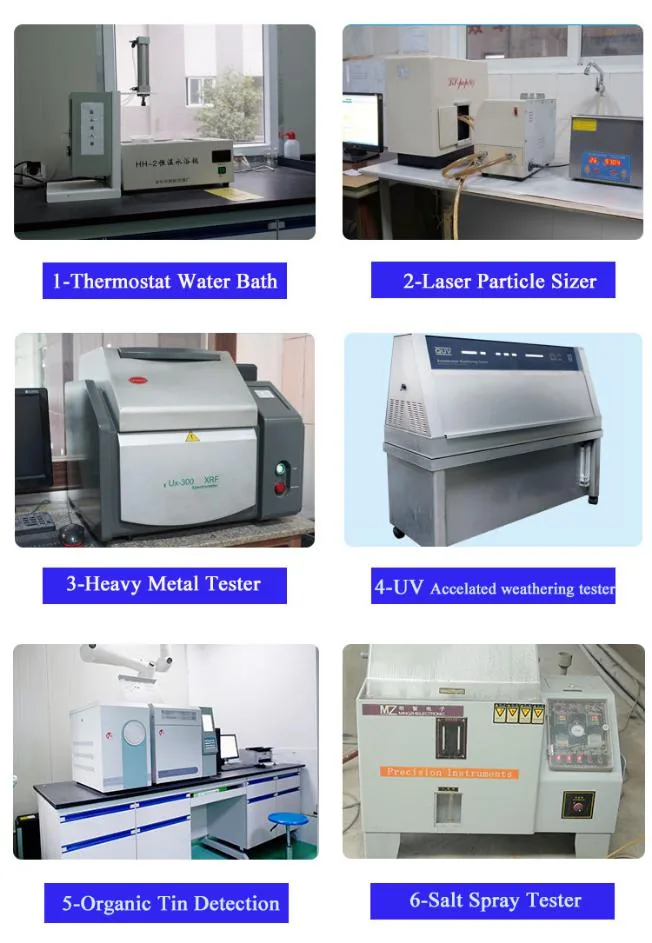
Panels 70 × 150 × 0.6–0.8 mm phosphated steel (0.2–0.3 mm for bend, impact, cupping), cured under agreed conditions and conditioned 24 h. Salt spray adhesion checked 24 h after exposure ends. Xenon-arc per ISO 16474-2 method 1: 0.51 W/m² at 340 nm, black-standard 65 ± 2 °C, RH 40–60 %, 18/102 min spray cycle. Tests run in WANAN's CNAS-accredited laboratory (L15415).
Downloads
Safety data, certificates, colour reference
- Material safety data sheet (MSDS), powder coating, Jan 2026PDF · 0.3 MB
- RAL K7 colour reference listPDF · 45 KB
- QUALICOAT certificate P-1982 (Class 2)PDF · 54 KB
- QUALICOAT certificate P-1436 (Class 1)PDF · 54 KB
- UL 1332 Certificate of Compliance, model WA-DQ 001APDF · 0.4 MB
- IATF 16949:2016 certificatePDF · 0.4 MB
- ISO 9001:2015 certificatePDF · 0.4 MB
- ISO 14001:2015 certificatePDF · 0.4 MB
- ISO 45001:2018 certificatePDF · 0.4 MB
- CNAS L15415 laboratory accreditation certificatePDF · 0.1 MB
SGS reports
Compliance test reports (2026)
Issued in Chinese; report numbers verifiable with SGS.
- SGS report CANEC25032179201 — RoHS Directive (White powder)4 Jan 2026
- SGS report CANEC25032179203 — RoHS Directive (Black powder)4 Jan 2026
- SGS report CANEC26014779202 — RoHS Directive (Gold powder)10 Jun 2026
- SGS report CANEC26001344801 — REACH SVHC screening (Powder coating (white + black + grey mixed))21 Jan 2026
- SGS report CANEC25032179214 — Soluble heavy metals (Powder coating (white + black + grey mixed))4 Jan 2026
- SGS report CANEC25032179206 — California Proposition 65 — lead (Powder coating (white + black + grey mixed))4 Jan 2026
- SGS report CANEC25032179208 — California Proposition 65 — cadmium (Powder coating (white + black + grey mixed))4 Jan 2026
- SGS report CANEC25032179210 — California Proposition 65 — phthalates (Powder coating (white + black + grey mixed))4 Jan 2026
Powder coating 101
How thermosetting powder coatings work, pretreatment, cure, film thickness and how to read a TDS.
Read →RAL reference & finishes
RAL K7 shades, metallic, texture and heat-transfer finishes, custom matching.
Browse →Certifications & compliance
Certificate numbers, scopes, validity and SGS report table.
View →Frequently asked questions
Do I need to register to download TDS or SDS?
No. Technical data for all five series is published in full on each product page, with every value tied to its ISO test method, and the MSDS, certificates and SGS reports are direct PDF downloads on this page. Formatted TDS PDFs for a specific series and colour, and SDS in additional languages, are sent by e-mail on request.
How do I calculate powder consumption?
Theoretical coverage in m²/kg equals 1000 divided by (specific gravity × film thickness in µm). For a WANAN P series powder at 1.5 g/cm³ and 100 µm the theoretical figure is about 6.7 m²/kg; at 80 µm about 8.3 m²/kg. Practical consumption is lower and depends on part geometry, transfer efficiency and reclaim, so line trials give the working figure.
What oven temperature should I set for 190–200 °C object temperature?
Higher than 190–200 °C, by an amount that depends on part mass, line speed and oven type. The TDS cure schedule refers to the metal surface temperature held for 10–15 minutes, not the oven set-point. Light sheet-metal parts reach temperature quickly; heavy castings and thick sections need a longer dwell or higher set-point, verified with a temperature-profile recorder on the actual part.
Need a formatted TDS or an SDS in another language?
Tell us the series, colour and destination market; the technical team sends the documents by e-mail.