What a thermosetting powder coating is
A thermosetting powder coating is a dry mixture of resin, hardener, pigments, fillers and additives, milled to a fine powder and applied to a grounded metal part by electrostatic spray at 40–100 kV. In the oven the powder melts, flows and cross-links into a continuous film that cannot be re-melted. Because there is no solvent, application produces essentially no VOC emissions and overspray can be reclaimed; the process is often described as the "4E" coating — efficient, energy-saving, economical and environmentally sound.
Chemistries and where they belong
| Chemistry | Strength | Limitation | Typical WANAN series |
|---|---|---|---|
| Epoxy | Corrosion and chemical resistance, adhesion, mechanical toughness | Chalks under UV; indoor or primer use | E (1440 h salt spray), EZ zinc-rich primer (≥ 2000 h) |
| Weather-resistant polyester | Colour and gloss retention outdoors, flexibility | Lower chemical resistance than epoxy | P480, P720, P1680 (500–1000 h xenon-arc) |
| Epoxy-polyester hybrid | Economical indoor decorative finish, good flow | Not for exterior exposure | Project grades |
| Polyurethane / acrylic | Specific appearance, chemical or clear-coat needs | Higher cost; specific cure behaviour | Project grades |
| Functional (insulating, high-temperature, low-cure, MDF) | Property engineered for the part | Specified per grade | Functional & decorative range |
Pretreatment decides adhesion and corrosion life
Every TDS value is generated on phosphated steel panels. On the production line, iron or zinc phosphate, chrome-free conversion coatings on aluminium, or zirconium/silane systems prepare the surface; degreasing and rinsing quality, and drying before the booth, decide whether the film adheres and whether corrosion creeps from scratches. Galvanised and cast substrates can outgas during cure and may need a degassing preheat or an outgassing-forgiving grade. Weld spatter, oil and fingerprints show through any powder.
Cure: object temperature, not oven set-point
WANAN series cure at 190–200 °C measured on the metal surface, held for 10–15 minutes. A light bracket may reach temperature in three minutes; a 10 mm machinery frame may take fifteen. Under-cure shows as poor solvent resistance, low impact and brittle adhesion; over-cure yellows light colours and reduces flexibility. A temperature-profile recorder attached to a real part is the standard check when a new part, oven or line speed is introduced.
Film thickness and coverage
The recommended 80–120 µm gives the hiding, edge coverage and corrosion protection behind the TDS values. Theoretical coverage is 1000 ÷ (specific gravity × µm): at 1.5 g/cm³ and 100 µm, about 6.7 m²/kg. Edges and inside corners carry less film because of the Faraday-cage effect; measure there. Reclaimed powder should be blended with virgin powder at a controlled ratio to keep particle-size distribution and appearance stable.
How to read a WANAN TDS
- Neutral salt spray, ISO 9227 — hours to the agreed corrosion criterion on scribed phosphated panels; compare series to series, not to field life.
- Humidity, ISO 6270-1 — hours in condensation without blistering or adhesion loss.
- Xenon-arc weathering, ISO 16474-2 — hours of accelerated exposure; gloss and colour change are evaluated.
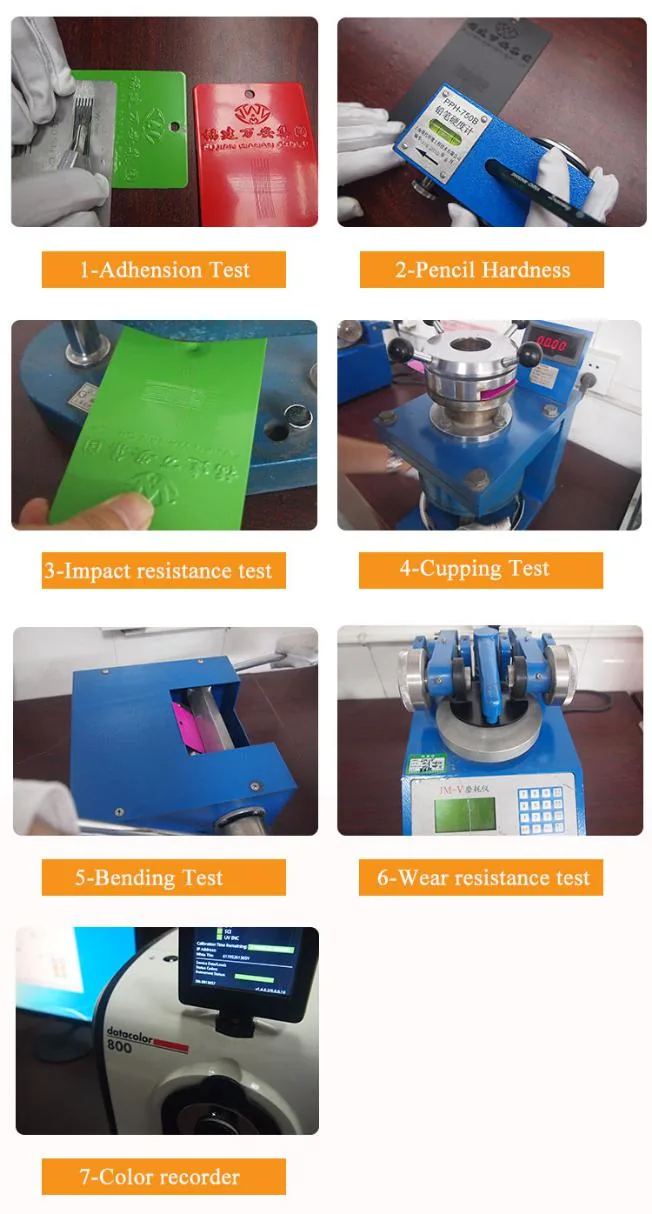
- Impact, ISO 6272-2; bend, ISO 1519; cross-cut, ISO 2409; pencil hardness, ISO 15184 — mechanical and adhesion properties of the cured film.
- Gloss, ISO 2813 at 60° — agreed per project.
Primer and topcoat values are never added: a two-coat system is tested as a system. Series names are designations, not hour counts.
Standards and approvals you will meet
Architectural aluminium projects reference QUALICOAT (Class 1, Class 2), GSB and AAMA 2603/2604/2605; WANAN holds QUALICOAT approvals P-1436 and P-1982. Outdoor electrical enclosures for North America reference UL 1332, where WANAN model WA-DQ 001A is a recognized component. Corrosivity categories C1–C5 (ISO 12944) guide primer/topcoat selection on structural steel. Restricted-substance compliance is documented by SGS reports against RoHS, REACH SVHC and California Proposition 65.
Frequently asked questions
What is the difference between epoxy, polyester and hybrid powder coatings?
Epoxy powders give the densest, most chemically resistant films and the best adhesion on steel but chalk under UV, so they are used indoors or as primers. Polyester powders keep colour and gloss outdoors; weather-resistant grades such as WANAN P480, P720 and P1680 are tested to 500–1000 h xenon-arc. Epoxy-polyester hybrids sit between the two for indoor decorative use, and polyurethane and acrylic powders serve specific appearance or chemical needs.
Why does the TDS quote object temperature instead of oven temperature?
Cross-linking happens in the film on the part, so what matters is the temperature the metal reaches and how long it stays there. WANAN specifies 190–200 °C on the object surface for 10–15 minutes. Oven set-points must be higher and the dwell longer for heavy parts; a thermocouple profile on the real part is the only reliable check.
How much film thickness should I apply?
WANAN series are specified at 80–120 µm dry film with a working range of 80–180 µm on the flat panel. Thin films reduce corrosion protection and hiding, especially on edges; very thick films can orange-peel, trap gas on castings or galvanised parts and waste powder. Measure on production parts at edges and recesses, not only on flat test panels.